
 Quality Leads That Turn Into Deals
Full-service marketing programs from TechNewsWorld deliver sales-ready leads. Segment by geography, industry, company size, job title, and more. Get Started Now.
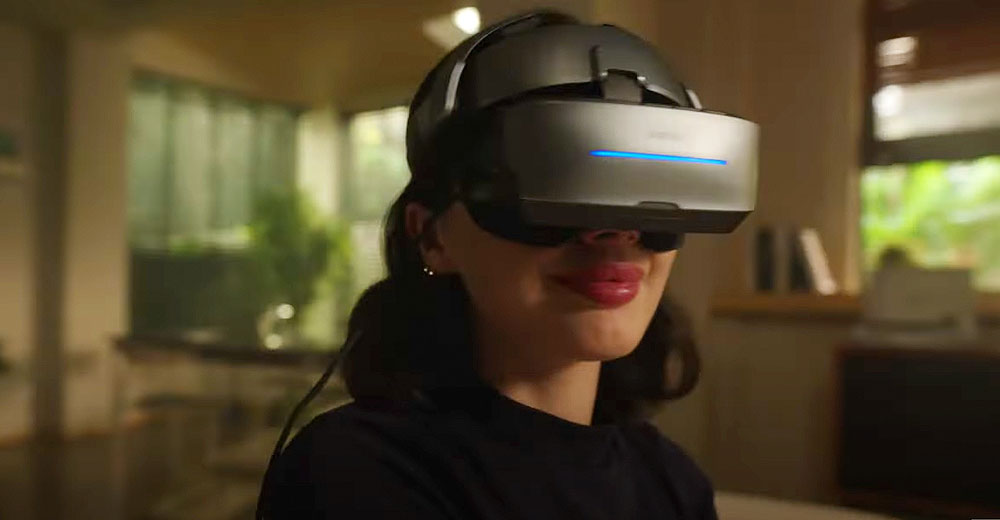
Like many of you, I was fascinated with the Apple Vision Pro head-mounted display when it was announced, but, as luck would have it, I had already ordered the Goovis G3 Max at Indiegogo. I’ve been using it for several weeks now. It is awesome for what it does and pretty much does what Tim Cook demonstrated on stage for the Vision Pro.
The enormous difference is that the Vision Pro lists for $3,499 while the G3 Max is only $869 on sale against a $1,299 list price. As an early buyer, I got mine for under $800, which was one heck of a deal.
Let’s talk about my experience with the Goovis G3 Max and how it might compare to the Apple Vision Pro when it arrives.
We’ll close with my Product of the Week, a headset that might be just what the doctor ordered for your desktop video conferencing needs.
Apple Vision Pro
Apple presented the Vision Pro as a pro-level product with all the technology built into the device. It’s fully stand-alone and does not seem to be able to be used as a screen for your laptop or iPhone. However, Apple’s WWDC presentation demonstrated how iOS apps, movies, and images would appear superimposed onto one’s surrounding environment using the Vision Pro.
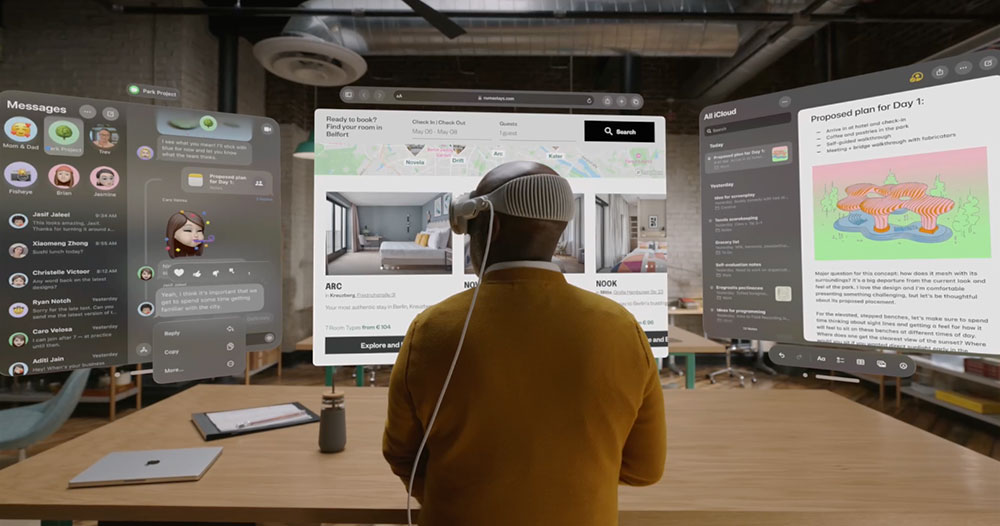
(Image Credit: Apple)
Apple’s strategy is always to try to sell you an additional expensive product. For instance, it has never created an all-in-one laptop that would also be a tablet. If you wanted a tablet, you bought an iPad; if you wanted a notebook, you bought a MacBook.
Initially, Apple mostly highlighted the Vision Pro’s video-playing capabilities and experience. The device is VR and game capable, but Apple doesn’t yet have VR content, and its platforms aren’t known for gaming capability. Vision Pro uses hand gestures to operate, with no controller, which suggests that if Apple does get into gaming, you will have to buy a controller accessory to make it work.
The voice part of the Vision Pro, which will be critical, is not yet cooked. Since Apple is not yet at the forefront of generative AI, I would expect some issues getting that capability to work. However, the eye and hand elements appear to be mature in comparison.
Vision Pro doesn’t look like it will work well with glasses, though contacts will be fine, and the price for an adaptive lens for the device is estimated to be between $300 and $600 extra if you need vision correction.
It fits very tightly against your face. There is no top support, but initial testers have complained that the pads may mark your face and the pressure can get annoying after extended use, like when watching a movie.
Videos should be impressive with 4K displays for each eye, and that tight fit keeps out ambient light. It has a digital crown, kind of like a watch, that allows you to control your level of immersion and potentially blends what the cameras on the device see with the content so you can see what is happening around you — though I wouldn’t wear these walking or driving.

Post a Comment